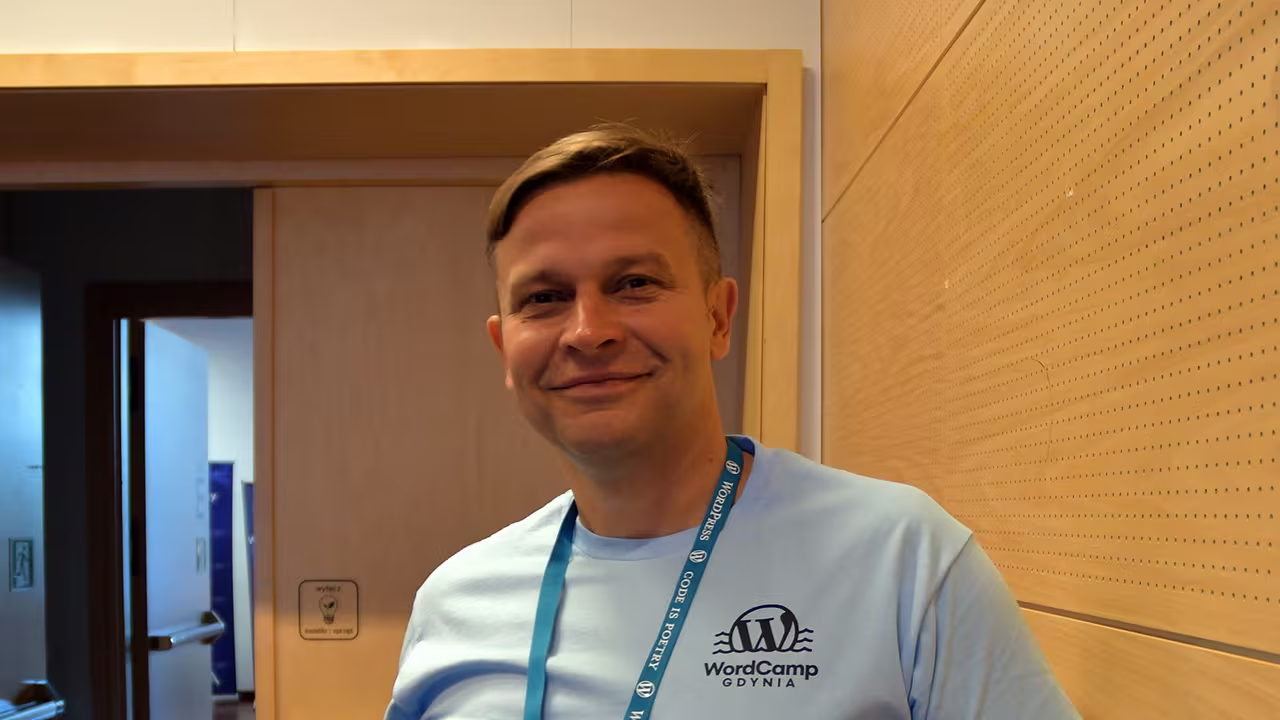
We came back from Kraków with mixed feelings, and from a vantage point that obliges us to be honest: we co-created WordCamp Europe 2026 from behind the scenes, on the budget team, so we watched this event not only from the room but from backstage. As an event, WCEU was excellent: 2,442 attendees from 81 countries, the venue, the people, and the city itself are hard to grade as anything but top marks. It was worse with what hung in the air between the talks. If you hold that first impression from the room up against the hard numbers, the picture becomes coherent and uncomfortable: WordPress is not dying, but for the first time in decades it is genuinely shrinking, and a good part of the ecosystem already has one foot out the door.
How WordCamp Europe 2026 went in Kraków
Contributor Day was full: 779 contributors across 26 teams, good energy, concrete conversations. And yet two things cast a shadow. The first was the founder’s absence: Matt Mullenweg announced on his blog that he decided at the last minute not to fly to Kraków and did not appear in person, explaining it as a wish to stay close to loved ones during a difficult time; Mary Hubbard and Matias Ventura led the closing. It is an understandable decision on a human level, but the leader’s absence from the community’s flagship event did not help the mood around the project’s leadership.
The second thing was subtler. In corridor conversations with product and agency owners, the same tone kept coming back: almost everyone is either looking beyond WordPress or already has one foot there. That is our impression from the room, not a survey, but when you lay it over the data it stops being just an impression.
Is WordPress market share below 42 percent in 2026
For years the industry repeated „WordPress is 43 percent of the web”. That sentence is no longer true. According to W3Techs, the share has fallen below 42 percent of all websites, and the monthly series shows a sixth consecutive decline: from 43.2 percent in December 2025 to roughly 41.9 percent at the end of May 2026. That is a drop of 1.3 points in half a year, roughly twice as much as across all of 2025. The HTTP Archive Web Almanac for 2025 describes the same phenomenon more cautiously: the first sustained slowdown after decades of expansion.
You can argue about the scale. A point or two of percent a year is still hundreds of millions of sites for the biggest player, and it is not a catastrophe. But the direction is unambiguous and the pace is accelerating, and that is what is new.
Which platforms sites leave WordPress for
The most interesting thing is not that WordPress is losing, but that no one in particular is gaining from it. Rival builders grow minimally and steadily: over a year, Wix added a fraction of a point, Shopify less, Squarespace and Webflow less still. None of these systems shows the share instability that WordPress does. The share moves to the „no recognised CMS” category, which over the same period grew from around 28.6 to around 29.5 percent. Those are static sites, front ends built on frameworks like Next.js, which reached 2.8 percent of all sites, lightweight stacks like Astro, and increasingly sites assembled by hand or with AI that leave no trace of WordPress at all.
It is a dispersed exodus, not a switch to a single platform. That is why it is hard to fit into one headline and why it is easy to play down. But this very pattern, many fleeing in many directions, is more dangerous than losing share to one rival.
How the WordPress decline affects plugin sellers and agencies
Here we reach a distinction that changes the whole picture and that came through more clearly in conversations than on stage. The decline hits the product side of the ecosystem hardest. Sales of commercial plugins and themes on marketplaces have been falling for years, and the number of new installs starting life on WordPress is far lower today than two or three years ago. If your business depends on bringing new users into a „free to paid” funnel for a low-value-add plugin, you have a real structural problem.
The service side looks different. Some agencies report their best years at the same time, and a few consciously go back to one hundred percent WordPress work, because at the service level the demand for well-built, maintained, and secure sites has not gone away. This is not a contradiction with the share data but its other side: the commodity market is shrinking, not the value market. For a site owner there is a simple conclusion in this. Stop asking whether WordPress is growing and start asking whether your provider delivers value beyond mere installation and whether they will cope when the project outgrows a single system.
AI content management in WordPress in 2026
The second recurring thread was about content and AI. The consensus, including among people close to the project core, was surprisingly aligned: nobody yet has a good, canonical process for AI-assisted content management in WordPress. Some people consider their flow decent, but usually because they have not seen how an agent works on a local static site, where changes to content, structure, and metadata happen in bulk and instantly, without clicking through a dashboard.
There is also a healthy counterpoint worth taking with humility: not everyone needs AI to manage content. Sometimes it is faster to simply write and publish than to build a complicated pipeline for its own sake. But where the scale of content is large, the advantage of a modern stack with files in a repository and an agent running locally becomes hard to ignore. This is one of the areas where WordPress, despite work on the core and on AI interfaces, is currently lagging.
Should you stay on WordPress or migrate
The worst reaction to this data is panic and blind flight; the second worst is pretending nothing is happening. WordPress is not dying; it still powers hundreds of millions of sites, and for large sites, shops, and editorial operations it is often the most sensible choice. But the market has matured enough that carrying on out of habit has stopped being safe.
Our conclusion after Kraków is pragmatic and boring, and therefore credible. Be on the side of value, not commodity. Build so that migration is an option, not a trauma: versioned code, clean data, no dependence on a single plugin. Work on the stack that fits the problem, not the habit, meaning WordPress where it wins on complexity and ecosystem, and a static stack with a modern front end where speed, maintenance cost, and AI content flow matter. This is exactly what we do day to day, and that is why we read WordPress’s declining share not as a threat but as the market reordering itself around what we considered right anyway.
If you are wondering which side of that line your project sits on, describe what it needs to achieve and we will assess together whether to stay with WordPress or prepare for migration.
This is analysis and our opinion, based on a first impression from WordCamp Europe 2026, which we helped create, and on public data and reports. The names WordPress and WordCamp are trademarks of their owners and we use them descriptively only.
Last updated: 12 June 2026.